
The tundish makes safety discharge visible; the D2 pipe then has to carry hot water and steam safely to a suitable termination.
A tundish is a small open funnel fitted into the discharge pipe of an unvented hot-water cylinder. It leaves a visible air gap so that, when a temperature or pressure relief valve lets by, the discharge can be seen rather than hidden. In G3 work it sits at the heart of a safety chain: the D1 pipe feeds the tundish, and the D2 pipe below it has to carry hot water and steam to a safe termination.
What the tundish is for
The tundish sits in the safety discharge route from an unvented hot-water system. Its job is not to make the fault disappear; it makes discharge visible and provides the air-gap break in the route. A dripping tundish is therefore a fault clue, not a feature to cap, hide or route into ordinary waste pipework without checks.
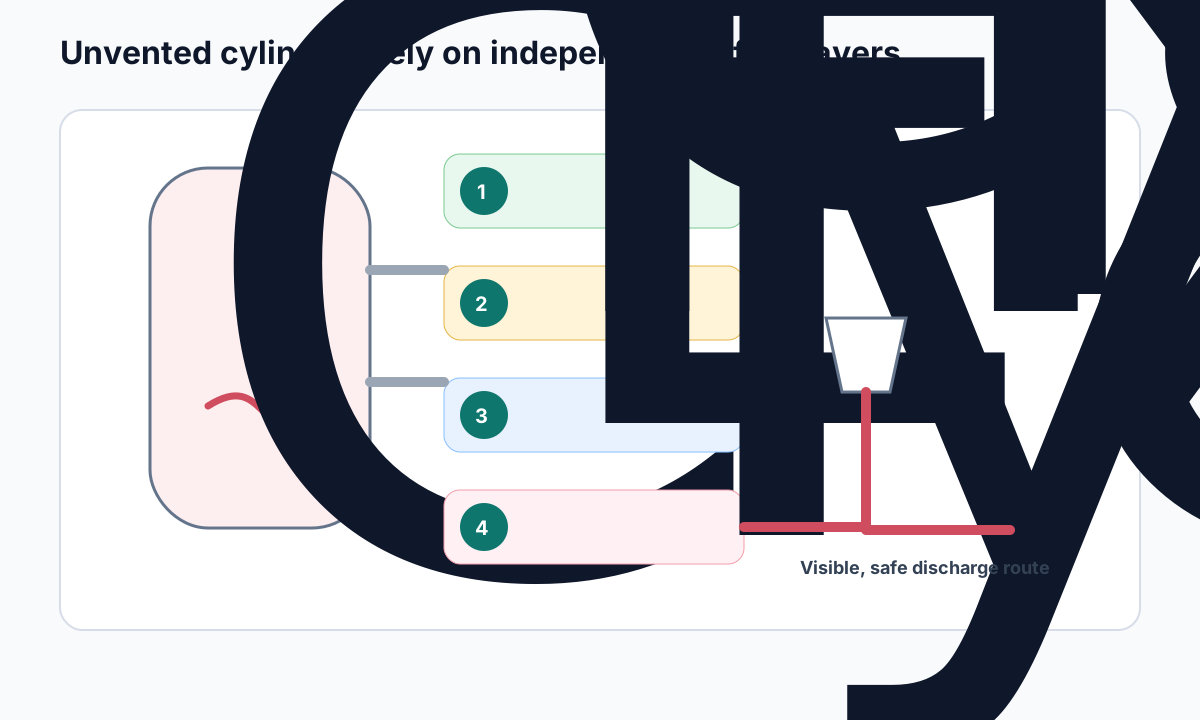
Tundish, drain, overflow or valve? Clearing up the terms
The tundish itself is not a valve and not a plain overflow — it is an open funnel that breaks the discharge route so the flow is visible. The valves sit upstream: the expansion (pressure) relief valve and the combined temperature and pressure relief valve on the cylinder. What people call the “tundish drain” is really the D2 discharge pipe carrying flow away from the tundish. Nor is it a routine overflow like a cistern warning pipe — anything showing at the tundish has come from a safety device operating, so it points to a fault to investigate, not normal running.
D1 and D2 in plain English
D1 is the short pipework from the safety valve outlet down to the tundish. D2 is everything downstream of the tundish, from the funnel to the final discharge point. The split matters because the two lengths are judged by different rules: D1 is about keeping the valve close to a visible break, D2 is about carrying a hot discharge safely all the way to somewhere it cannot hurt anyone.
The learner mistake is treating D2 like ordinary overflow or waste pipe. It may have to carry water near boiling point, and steam, from a safety device that has just operated. Size, material, route, support and termination all matter. Size D2 against the safety valve outlet and the resistance of the discharge route.
Keep the measurements separate: 600 mm is the maximum D1 pipe length, 300 mm is the minimum straight vertical D2 drop before a bend, and 1 in 200 describes the fall afterwards — 5 mm per metre. These figures use England’s guidance.
- D1 — valve outlet to tundish: keep it as short as it can be, with no more than 600 mm of pipe between the valve outlet and the tundish.
- The tundish sits vertically, below the valve, somewhere it can actually be seen.
- D2 — tundish to termination: size from the safety valve outlet, allowing for the route and bends.
- D2 drops at least 300 mm vertically below the tundish before any elbow or bend.
- After that vertical leg, D2 runs with a continuous fall — 1 in 200 is the minimum guide value.
Sizing D2: why the length limit moves
The bend allowance changes with the copper pipe diameter. In Table 3.1 of England’s Approved Document G, each 22 mm bend adds 0.8 m of equivalent length, each 28 mm bend adds 1.0 m, and each 35 mm bend adds 1.4 m. Do not carry the 0.8 m allowance across every pipe size.
For a G½ temperature relief valve with 15 mm D1, the straight-equivalent limits are 9 m for 22 mm copper D2, 18 m for 28 mm and 27 m for 35 mm. Add the actual pipe length and the bend allowances, then compare with the limit for that valve and candidate diameter. Plastic systems need their own bore and resistance data.
Worked D2 sizing check
Take a G½ valve, 15 mm D1 and a proposed copper D2 route measuring 6 m with five elbows. At 22 mm, the equivalent length is 6 + (5 x 0.8) = 10 m, exceeding the 9 m limit.
Recheck at 28 mm using its own bend allowance: 6 + (5 x 1.0) = 11 m, within the 18 m limit. That passes this sizing check; the fall, initial vertical drop, materials and termination still need checking against the applicable guidance and cylinder instructions.
Approved Document G points to remember
- Discharge should be visible at the tundish.
- D2 needs at least 300 mm of vertical pipe below the tundish before bends are introduced.
- After that initial vertical section, D2 should run with a continuous fall of at least 1 in 200.
- D2 material must be suitable for the temperature of the discharge.
- D2 sizing is not just a nominal pipe size; bends and effective length reduce capacity.
- A common discharge pipe serving more than one system needs extra sizing care.
- Termination must be in a safe place where people are not put at risk by hot discharge.
Termination examples
Approved Document G gives example discharge arrangements such as a suitable trapped gully arrangement, guarded low-level discharge, or high-level discharge into metal rainwater goods or onto a suitable roof area. Check each arrangement’s conditions: discharge is visible at the tundish, the route withstands the temperature and the termination cannot expose people to hot discharge.
Soil-stack connection and mechanical seal
A soil-stack connection needs a stack suitable for the discharge temperature, a mechanical seal that keeps foul air out without using a water trap, and a separate branch with no sanitary appliances. The branch also needs suitable materials and warning markings. This is a controlled arrangement, not an ordinary waste connection.
The visible warning remains at the tundish. A final connection inside a suitable soil stack can meet these conditions; an open pipe ending in a concealed wall void cannot.
What a discharge at the tundish tells you
Water at the tundish means a relief valve has opened. Note three things before touching anything: which valve it is coming from, whether it appears only while the cylinder heats or all the time, and whether it is cold or very hot. The pattern narrows the search; it does not name the failed part. Settings and the order of checks differ between cylinders, so the fault-finding chart in the installed cylinder’s instructions decides, and work on these controls needs unvented competence.
- Only while the water heats, from the expansion relief valve: the expanding water has nowhere to go. Check the expansion provision by the manufacturer’s method — an external vessel’s pre-charge with its water side depressurised, or the recharge procedure for an internal air gap.
- All the time, from the expansion relief valve, even with no heat input: compare the pressure reducing valve’s outlet pressure with the cylinder’s stated setting, then look for debris or damage on the relief valve seat.
- Very hot water or steam from the temperature and pressure relief valve: treat it as a thermal control failure. Switch off every heat source to the cylinder — immersion heaters and boiler — and keep clear of the discharge. Some manufacturers also say to leave the water supply on until it stops, so read the instructions before isolating anything else.
- Nothing discharging today, but staining or scale below the tundish: signs of past discharge are one of the things an annual service looks for. Record them and check the same three points. The G3 revision notes cover expansion vessels and the service checks in full.
Common exam mistakes
- Saying the tundish is just an overflow.
- Hiding the tundish where discharge cannot be noticed.
- Running D2 uphill or through a route that traps water.
- Using ordinary plastic waste pipe without proving temperature suitability.
- Forgetting bends when thinking about D2 sizing.
- Treating repeated tundish discharge as normal operation.
Quick answers
What does a tundish do on an unvented cylinder?
It makes safety discharge visible and forms part of the discharge route from relief devices, so faults are noticed rather than hidden.
What is D1 and D2 pipework on an unvented cylinder?
D1 connects the safety valve to the tundish; the illustrated arrangement allows no more than 600 mm between them. D2 runs from the tundish to the discharge point and is sized from the valve outlet and route resistance.
What size should the D2 discharge pipe be?
Choose it from the safety valve outlet size and the discharge route’s equivalent length. Bend resistance depends on diameter: for copper, use 0.8 m per 22 mm bend, 1.0 m per 28 mm bend or 1.4 m per 35 mm bend. Check the applicable Approved Document G table and manufacturer instructions.
Where can a D2 discharge pipe terminate?
At a safe termination that can withstand the discharge temperature. Examples include a trapped gully, a guarded low-level outlet or a suitable high-level arrangement, each with its own conditions. A soil-stack connection is also permitted when the temperature, mechanical-seal, separate-branch and marking requirements are met. Discharge must remain visible at the tundish; the final connection need not always be exposed.
Can unvented discharge go into plastic waste pipe?
Not ordinary waste pipe. In England’s Approved Document G, D1 is metal. D2 is metal, or another material demonstrated to withstand the discharge temperature and permanently marked with its product and performance standard. For a permitted soil-stack branch, the plastics it names are polybutylene or cross-linked polyethylene to Class S of BS 7291. Check the cylinder instructions too.
Is a dripping tundish normal?
No. Visible discharge is a fault clue. The cause should be investigated rather than capped or ignored.
Is a tundish a valve or an overflow?
Neither. A tundish is an open funnel that gives a visible air break in the discharge route. The valves — the expansion relief valve and the temperature and pressure relief valve — sit upstream on the cylinder.
What is the tundish drain pipe?
The pipe below the tundish is the D2 discharge pipe. It must run at least 300 mm vertically before any bend, then fall continuously, and be able to carry hot water and steam to a safe termination. The tundish provides the visible warning of discharge.
What regulations cover a tundish?
For domestic work in England, Part G covers hot-water safety and Approved Document G explains the discharge arrangements. Wales has its own Approved Document G; Scotland and Northern Ireland have separate guidance. Use the applicable edition alongside water fittings rules and the cylinder instructions.
Can the D2 discharge pipe be trapped?
Do not fit an ordinary water trap in D2. A trapped-gully termination keeps the pipe end above the water seal and below the fixed grating. A permitted soil-stack connection instead uses a suitable mechanical seal without a water trap, with the other temperature, branch and marking conditions satisfied.
Can another appliance drain run into the tundish?
No. The tundish serves the cylinder safety discharge, and its open break is what stops anything in the drainage system reaching the relief valve. Running another drain into it also makes a discharge impossible to attribute — the point of the tundish is that you can see which safety device operated.
Should the discharge outlet be guarded?
A low-level external termination is normally fitted with a wire cage guard. It does two jobs: it keeps people and animals away from water that can be near boiling, and it keeps the outlet from being blocked. A guard is not a fine mesh — the discharge has to stay clear, so anything that could clog it is the wrong fitting.
Can the D2 discharge pipe run into a condensate pump?
No. England’s Approved Document G describes D2 as a gravity route: at least 300 mm of vertical pipe below the tundish, then a continuous fall of at least 1 in 200 to a safe termination. A relief discharge can be near-boiling water and steam, arriving far faster than condensate, and a pump stops when its power does. If the fall cannot be achieved, the discharge route needs redesigning, not pumping.
Why does the tundish drip only while the water is heating?
Discharge that appears during heat-up and stops afterwards suggests the expanding water has nowhere to go, so the expansion relief valve opens. Check the expansion provision by the manufacturer’s method: an external vessel’s pre-charge, or the recharge procedure for an internal air gap. The symptom alone does not prove the vessel has failed.
Why is water running from the tundish all the time?
Continuous discharge with no heat input points to the supply side or a valve that is not seating: compare the pressure reducing valve’s outlet pressure with the cylinder’s stated setting and check the relief valve seat. If the water is very hot, treat it as a thermal control failure, switch off every heat source to the cylinder and follow its instructions.
Does Approved Document G apply in Scotland?
No. Scotland uses the Building (Scotland) Regulations and Scottish Technical Handbooks. England and Wales publish separate versions of Approved Document G, and Northern Ireland uses its Technical Booklets. Check the figures, permitted arrangements and notification requirements for the location of the work.