
Recognise the two unsafe classifications, ID and AR, and the required actions. Record safe NCS shortfalls separately from the unsafe-situations procedure.
Unsafe-situation revision connects the condition found with the action needed to protect people. Assess whether there is an Immediately Dangerous or At Risk condition using the current procedure. A safe standards shortfall may be recorded separately as NCS; it is outside GIUSP. This guide introduces those distinctions, warning records and customer permission alongside the need for competent assessment of the actual installation.
Unsafe situations: classify and act
A revision prompt for the order of thinking. Real decisions follow the current GIUSP, the installation in front of you and competent judgement.
- Danger to life or property now, or the instant it is used? → Immediately Dangerous.
- Not now, but could become dangerous in use? → At Risk.
- Assessed as a safe standards shortfall? → Record separately; NCS is outside GIUSP.
- ID: with permission turn off and disconnect, attach a “Danger Do Not Use” label, issue a warning notice.
- AR: with permission turn off, attach a “Danger Do Not Use” label, issue a warning notice, no use until repaired. Where turning off would not reduce the risk, refer it instead, with a notice but no label.
- NCS: advise on the job report, not on the warning notice; the appliance may stay in use.
- Permission is needed before turning off or disconnecting a customer’s appliance.
- ID with permission refused: try to turn it off, warn the customer, then contact the gas emergency service (0800 111 999) for natural gas or the gas supplier for LPG.
- Check whether the dangerous gas fitting meets the RIDDOR reporting criteria; not every unsafe finding is reportable.
Revision aid only — not authority to work on gas. Making safe and disconnection are for competent Gas Safe registered engineers.
Where the rules come from: GSIUR and GIUSP
Two things are easy to mix up. The Gas Safety (Installation and Use) Regulations 1998 — GSIUR — are the law. They set the duties: only competent, Gas Safe registered people work on gas, and anyone who knows of a gas fitting that is or may be dangerous has to act on it rather than leave it. GSIUR says you must deal with an unsafe situation; it does not spell out the step-by-step method.
The method is the Gas Industry Unsafe Situations Procedure — GIUSP — published by IGEM as IGEM/G/11, Edition 2, most recently amended in July 2025. It replaced Gas Safe Register’s Technical Bulletin 001, which carried the older Edition 7.1 and is now withdrawn. GIUSP is what turns "this is unsafe" into a defined classification and action. So in revision terms: GSIUR is the legal duty, GIUSP is how you carry it out. If a question asks what you must do about a defect, it is testing GIUSP; if it asks who may work on gas or what the law requires, it is testing GSIUR.
This page is revision support, not authority to carry out gas work. Live testing, disconnection and making safe are for competent Gas Safe registered engineers following the current procedure and manufacturer instructions.
The unsafe categories and the separate NCS description
GIUSP uses two unsafe classifications: ID and AR. NCS was removed from the procedure because it describes a safe standards shortfall. Businesses may still record and advise on that shortfall separately.
- Immediately Dangerous (ID): a danger to life or property is present now, or would be the moment the appliance or installation is used. This is the most urgent outcome.
- At Risk (AR): one or more recognised faults exist that are not a danger right now but could become one in use. Serious, but not an immediate emergency.
- Not to Current Standards (NCS): a safe standards shortfall, outside the current GIUSP unsafe classifications. Record and advise separately.
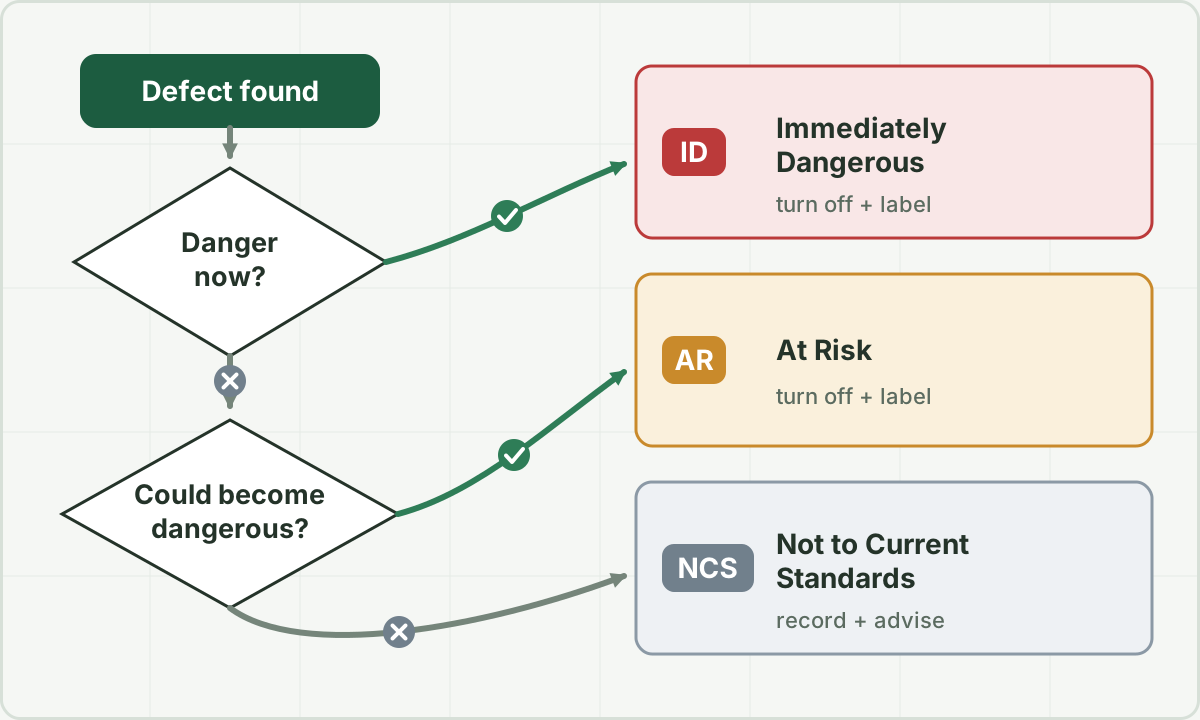
The two questions that sort any defect
You do not memorise a list of which faults are ID and which are AR — installations differ, and the assessment rewards the reasoning, not rote recall. Instead you ask two questions in order.
- Question one: is this a danger to life or property now, or would it be as soon as the appliance is used? If yes, it is Immediately Dangerous and you stop there.
- Question two (only if the first is no): could this defect become a danger to life or property in use? If yes, it is At Risk.
- Where assessment establishes a safe standards shortfall, record and explain it separately. NCS is not a third GIUSP unsafe category.
Immediately Dangerous (ID): the action
For an ID situation the priority is to remove the danger. With the customer’s permission, turn off and disconnect the appliance or installation and make it safe, attach a “Danger Do Not Use” label, and issue a warning notice recording what you found and did, asking the responsible person to sign it. The point examiners look for is that you leave the situation safe, not merely documented.
Permission is the twist. You cannot force your way onto a customer’s appliance — turning off and disconnecting needs their agreement. If permission to disconnect is refused, try to turn the appliance off and warn the responsible person clearly of the danger. For natural gas, contact the gas emergency service straight away (0800 111 999) and record the job reference and the time; the emergency service has legal powers to make a natural gas installation safe. For LPG, contact the gas supplier instead, because those powers do not extend to LPG unless the supply contract gives a right of entry. A "safe" answer never involves leaving a known immediate danger connected and simply walking away.
At Risk (AR): the action
For At Risk, again with the customer’s permission, turn off the appliance or installation, attach a “Danger Do Not Use” label, issue a warning notice, and advise that it must not be used until the fault is put right. In a few At Risk cases turning off would not reduce the risk, for example a building put up over a plastic gas service pipe or an LPG bulk tank sited in the wrong place. Those are referred to the responsible person or organisation to resolve: no label is attached, and the warning notice says who to contact. The difference from ID is urgency and framing: there is no present emergency, so the emphasis is on preventing use until repair rather than on emergency escalation. If the customer refuses to let you turn it off, you advise and record — you cannot compel them, but you make the risk and the advice unmistakable.
Turning off has a set order: the appliance isolation valve; if that is not possible, remove the electrical fuse; if that is not possible either, turn off the appliance control and fix the label to it. Turning down a room thermostat or setting the timer to off is not acceptable.
NCS: a separate record of a safe standards shortfall
NCS was removed from the procedure in Edition 7 (2015), because a shortfall against current standards is not unsafe; Gas Safe Register inspected against that edition from July 2016. You can still tell the customer that the installation is below current standards and why, and recommend it is brought up to standard. Put that advice on your job report, not on a warning notice or other safety paperwork. The appliance may stay in use because it is safe now. A classic exam trap is over-classifying a purely cosmetic or historic non-conformity as At Risk. If it is safe today and would not become dangerous in use, it is NCS.
Labels, warning notices and the paperwork
- A warning notice records the defect, the classification and the action taken, and the responsible person is asked to sign it to show they have received and understood it. A copy is left with them, or on site if no one is there, and you keep a copy. Being able to say what a warning notice is and who gets it is common in questions.
- The “Danger Do Not Use” label is attached to the appliance or installation, whether it is Immediately Dangerous or At Risk, so the danger is visible to anyone who approaches it, not just the person who took the paperwork. The warning notice records which category it is.
- Turning off or disconnecting always needs the customer’s permission first — this single rule underpins the "what if they refuse" branch of most scenarios.
- RIDDOR is a separate legal duty. Report to HSE within 14 days any gas fitting, including flues and ventilation, that is dangerous enough to cause or be likely to cause death, unconsciousness or hospital treatment because of its design, installation, modification or servicing, even if you repaired it on the spot. A fitting that is dangerous only through lack of maintenance is not RIDDOR-reportable, so not every ID or AR finding is reportable. Make it safe first, then report.
- If the gas user is not the owner, for example a tenant, give the owner or managing agent the details in writing.
- Record any refusal to disconnect, turn off or sign: a refusal does not remove the danger. Keeping your records for at least six years is advisable.
Worked scenarios: classify then act
- An open-flued heater is spilling combustion products into the room while it runs. Danger now → Immediately Dangerous: with permission turn off and disconnect, label ID, issue a warning notice, and if permission is refused warn and call the gas emergency service.
- An open-flued appliance works normally, but its existing flue terminal is in a prohibited zone. Nothing is spilling now, but it could become dangerous in use → At Risk: with permission turn off, attach a “Danger Do Not Use” label, issue a warning notice and advise no use until it is corrected. If a CO alarm has sounded or someone has had symptoms, and the terminal could let products into the property, treat it as Immediately Dangerous.
- An older but sound installation uses a fitting that today’s standard would site differently, with no danger now or in use → Not to Current Standards: record, inform and advise, appliance stays in use.
- You find a genuinely immediately dangerous appliance and the customer refuses to let you disconnect it. You do not simply leave: you try to turn it off, warn them plainly of the danger, make the classification clear on the notice, and contact the gas emergency service for natural gas or the gas supplier for LPG. Refusal changes your options, not the danger.
Worked classifications: flue terminals and flame supervision
IGEM/G/11 includes a table of common situations with the category the industry applied to each. The table is not exhaustive, and the final decision is the engineer’s, based on the installation in front of them and the appliance manufacturer’s instructions. Its entries show the two questions in use: is it a danger now, and if not, could it become dangerous in use?
- An existing open flue whose terminal is in a prohibited zone: At Risk. If products are spilling into the room, it is Immediately Dangerous instead.
- A natural-draught open flue ending beside or facing a wall: At Risk. The procedure says this termination is not acceptable for any natural-draught open-flued appliance.
- An existing open flue with defects such as a non-compliant terminal position, too little vertical rise before the first bend or an unsuitable terminal: the engineer decides whether the defects are serious enough to make the installation At Risk.
- A missing flue terminal or a damaged flue, with no combustion products entering the building: At Risk.
- A flue that now discharges into an internal space, such as a conservatory built around a room-sealed terminal: Immediately Dangerous.
- A terminal that could let products of combustion into the property, where a CO alarm has gone off or someone has had symptoms: Immediately Dangerous. Confirmed re-entry of products that raises the CO level in the building is also Immediately Dangerous.
- A flame supervision device that does not work, fails to danger or has been disabled: Immediately Dangerous. The same entry covers other safety devices, including regulators, spillage monitoring devices, air pressure switches and high-limit thermostats.
- A catering appliance with an enclosed burner that was never fitted with a flame supervision device: At Risk. If a device was fitted and no longer works, the Immediately Dangerous entry applies.
- Two or more appliances on one flue where one of them has no flame supervision device: At Risk.
Exam angle and common mistakes
- Getting ID and AR the wrong way round. Ask the "danger now?" question first and answer it honestly — present danger is ID, potential-in-use is AR.
- Treating NCS as "ignore it". NCS still means record, inform and advise; the appliance staying in use is a conclusion, not a licence to say nothing.
- Forgetting permission. Any answer that turns off or disconnects a customer’s appliance without noting that permission is needed is incomplete, and the "permission refused" branch is a favourite.
- Confusing GSIUR with GIUSP. The regulations are the legal duty; the procedure sets the ID and AR safety actions — name the right one for what the question asks.
- Leaving a known immediate danger connected. The safe answer always removes or contains the danger and escalates when permission is refused.
Quick answers
What is the gas unsafe situations procedure?
It is GIUSP — the Gas Industry Unsafe Situations Procedure, published by IGEM as IGEM/G/11, which replaced Gas Safe Register’s withdrawn Technical Bulletin 001. It classifies unsafe situations as Immediately Dangerous or At Risk and sets the corresponding actions. NCS describes a safe standards shortfall outside the procedure.
What is the difference between GSIUR and GIUSP?
GSIUR is the Gas Safety (Installation and Use) Regulations 1998 — the law and the duties. GIUSP is the procedure you follow to classify and act on an unsafe situation found under those duties. GSIUR is the requirement; GIUSP is the method.
What does Immediately Dangerous mean?
A situation that is a danger to life or property now, or would be the moment the appliance or installation is used. With permission you turn off and disconnect, attach a “Danger Do Not Use” label and issue a warning notice. If permission is refused, you try to turn it off, warn the customer and contact the gas emergency service for natural gas, or the gas supplier for LPG.
What is the difference between At Risk and Immediately Dangerous?
Immediately Dangerous is a danger now or as soon as the appliance is used. At Risk means the fault is not dangerous at this moment but could become dangerous in use. Ask "is it a danger now?" first — yes is ID, no-but-could-be is AR.
Do you need permission to disconnect a gas appliance?
Yes. Turning off or disconnecting a customer’s appliance needs their permission. If they refuse for an Immediately Dangerous situation, you try to turn it off, warn them of the danger, record it, and contact the gas emergency service for natural gas or the gas supplier for LPG, rather than leaving the danger connected.
What is a warning notice?
The warning notice records the defect, its classification and the action taken, and the responsible person is asked to sign it. A copy is left with them or on site and you keep one. A “Danger Do Not Use” label goes on the appliance as well.
When is a gas fitting reported under RIDDOR?
A registered engineer must report a dangerous gas fitting when it meets the RIDDOR criteria. An unsafe classification alone does not establish reportability. Make the situation safe first, then assess the reporting duty: a reportable dangerous fitting goes to HSE online within 14 days of discovery, and one repaired on the spot must still be reported.
How is a badly sited flue terminal classified?
It depends on the flue and on what is happening. In the current procedure, an existing open flue ending in a prohibited zone, or a natural-draught flue ending beside a wall, is At Risk. A flue discharging into a conservatory or other internal space is Immediately Dangerous. A terminal that could let products into the property is Immediately Dangerous if a CO alarm has gone off or someone has had symptoms. Which positions are non-compliant depends on the flue type, the appliance instructions and the standards.
Is a faulty flame failure device Immediately Dangerous?
Yes. The current procedure classes a flame supervision device that is inoperative, failing to danger or disabled as Immediately Dangerous, along with other safety devices such as regulators and air pressure switches. A catering appliance with an enclosed burner that was never fitted with one is At Risk.
What label does a gas engineer put on an unsafe appliance?
A “Danger Do Not Use” label, whether the appliance is Immediately Dangerous or At Risk, together with a warning notice that records the category. The exception is an At Risk situation where turning off would not reduce the risk: there is no label, and the notice says who to contact.
Is Not to Current Standards still used?
Not in the unsafe situations procedure. NCS was removed in 2015 because a shortfall against current standards is not unsafe. Engineers can still advise a customer about one on the job report, but not on the warning notice. Gas Safe Register still uses NCS in its own inspections of registered engineers’ work.